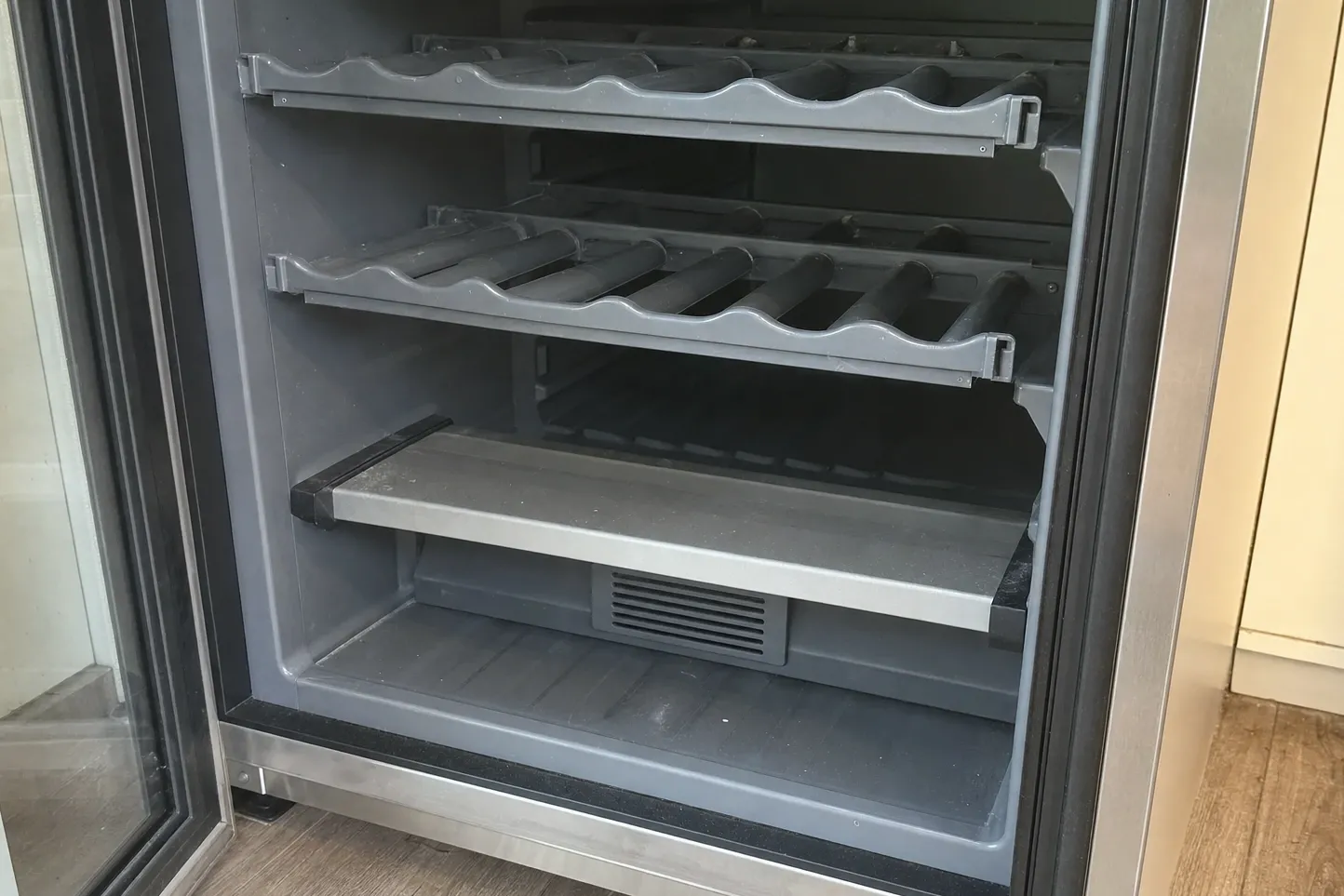
Refrigerator Repair
The Hour After the Lights Come Back: Restarting a Sub-Zero in a Phoenix Monsoon Outage
After a monsoon outage, a Sub-Zero that hums, clicks and cuts out is usually a compressor restarting against pressure that has not equalised — not a failed part. Here is what to wait for, what to check, and when the outage really did break something.
Written by
Warren Ibarra
Refrigeration technician — condenser and heat-load work · 20 years in the trade
A monsoon cell takes out a feeder somewhere in the Valley most weeks between July and September. In July 2024 a microburst with gusts reported at 77 mph went through west Phoenix and left roughly 31,000 customers without supply at the peak; about 1,500 SRP and just under 4,000 APS customers were still out the following afternoon. A 2023 storm cut more than 71,200 SRP customers at its height. Those are news-reported utility figures and they move around between sources, but the shape is consistent: tens of thousands of houses, dark for hours, in the months when it is hottest.
The hour after the lights come back is where most of our monsoon calls are actually made. Not during the outage — after it.
What people here assume is wrong with it
That the outage broke something. The unit came back on, hummed, clicked, cut out, sat warm all evening, and the conclusion is that the surge killed the compressor or the board.
Sometimes that is true. Far more often the unit is doing the only thing it can do when it is asked to restart against a system that has not equalised, in a house that has been closed up with no cooling for six hours, in a month when the outside air is doing what it did in July 2023 — thirty-one consecutive days at or above 110°F, against a previous record of eighteen days set in 1974, and a monthly average of 102.7°F that stands as the hottest calendar month recorded for any US city.
The second assumption worth dismantling: that a fresh-food compartment sitting near fifty degrees while the freezer side is still hard means the refrigeration is dead. In a dual-evaporator built-in it usually means one section is recovering faster than the other, which is exactly what you would expect.
What is actually happening
When a compressor stops under load, high pressure stays on the discharge side and low pressure on the suction side. It takes several minutes for those to bleed back to equal. Restart it before that happens and the motor is being asked to start against a column of high-pressure refrigerant it cannot overcome — it draws locked-rotor current, the internal overload opens, and it stops. Then it tries again. That cycle of hum, click, silence, hum is a protection device working, not a part failing.
Layer the Phoenix ambient on top. Heat rejection gets harder as the air around the condenser gets hotter, and after a long outage the kitchen, the pantry alcove and above all the garage are hot right through the wall cavity. 2023 saw fifty-four days at or above 110°F, past the previous record of fifty-three in 2020, and seventeen days at or above 115°F where the old record was six. A unit restarting into that has both a pressure problem and a capacity problem at the same moment.
Then there is dust. The same storms that drop the feeder blow fine grit through everything, and a condenser that was marginal in June is blanketed by September. Estrella and South Mountain houses take that worst — new build or old ranch, it does not matter, what matters is what the wind carried across the lot.
The evidence, in the order we look at it
First, supply. Is the circuit actually live and stable at the outlet, or did the branch trip when the feeder re-energised? A GFCI or breaker that reset itself is a very different story from one that will not hold.
Second, elapsed time. If the power has been back under about a quarter of an hour, the correct action is to wait, not to diagnose. Many built-ins hold themselves off deliberately for a few minutes after a power event.
Third, the split between compartments. Both sections warm points one way; one warm and one cold points at airflow, a defrost fault or a fan, and the packet of symptoms that comes with it — a condenser fan howling or dead after a dust storm — usually names the part before we open anything.
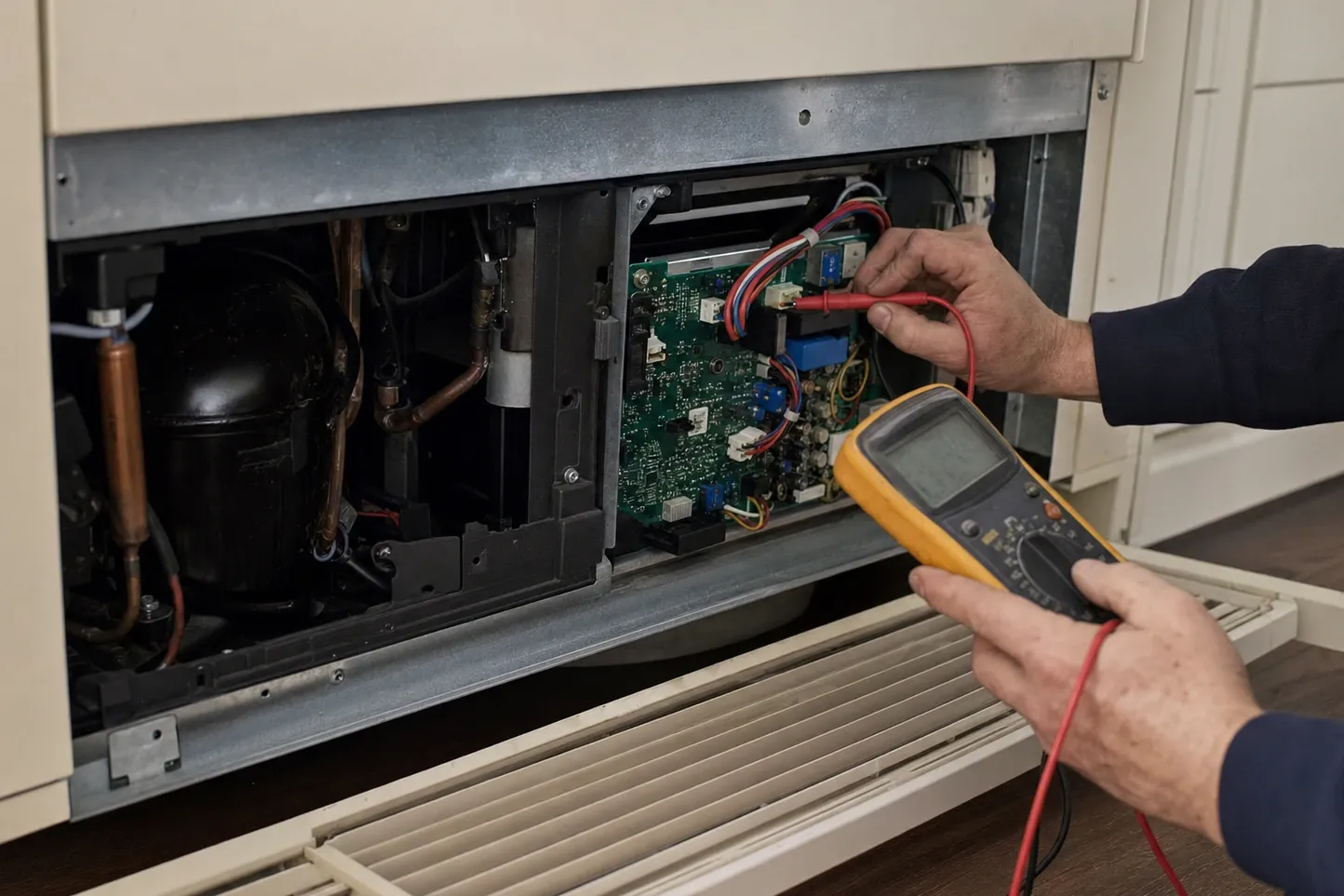
Fourth, the condenser itself. Grille off, fins inspected and cleaned, fan spun by hand, motor checked for the bearing drag that grit produces.
Fifth, run behaviour over time. A unit that pulls down steadily and satisfies is a unit that had an outage. A unit that runs all afternoon in an Alhambra galley kitchen without ever satisfying has a real fault, and the ambient is not an excuse for it.
Only then does anyone talk about the sealed system.
The fix that holds
For the restart itself, the fix is patience and sequence. Leave the doors shut. Give the unit fifteen to twenty minutes of settled power before judging it. Do not pull the plug and push it back in repeatedly — each attempt against unequalised pressure is another locked-rotor event, and that is the mechanism that turns an outage into a compressor call.
For the underlying vulnerability, the fix is the condenser and the clearances. In a Garfield bungalow where a built-in is wedged into a very tight kitchen wall, and in any installation sharing an alcove with a garage wall, the difference between a cabinet that shrugs off a monsoon restart and one that does not is almost always how freely it can dump heat.
For the electronics, a whole-house or dedicated surge device is the sensible response to a metro where the supply drops several times a season. It is cheaper than the board.
Food is the one thing not worth optimism about. If the doors stayed shut, the compartments hold for hours. If they were opened repeatedly during the outage, or the fresh-food side has been near fifty degrees for an evening, throw out what should have stayed cold and be unsentimental about it.
Where to stop and call
Stop if the breaker will not stay in, if there is any burnt smell around the cabinet, if the unit hums and cuts out repeatedly for more than half an hour after stable power has returned, or if the fresh-food side has not started falling within four to six hours.
A diagnostic visit is $89. An evaporator or condenser fan motor runs $340 to $650, and a defrost heater, thermostat or sensor $300 to $670. Door gasket or seal work is $290 to $650, ice maker, water valve or supply line $270 to $860, and an electronic control board $440 to $880. Compressor and sealed-system repair is $1,500 to $3,310, which is precisely why we would rather talk you through a restart on the phone than sell you one.
A call to (623) 323-6690 settles in five minutes what a form cannot.
Follow-up questions
- How long should I wait after a monsoon outage before calling?
- Give it fifteen to twenty minutes of settled power before judging it at all, and four to six hours before deciding it is not recovering. Many built-ins deliberately hold themselves off for a few minutes after a power event, and a compressor asked to start too early simply opens its own overload protection and stops again.
- Can I unplug it and plug it back in to force a start?
- Please do not. Every attempt puts the motor up against pressure that has not yet bled down to equal, and repeating that is one of the few things a homeowner can genuinely do to convert a recovering appliance into a sealed-system repair at $1,500 to $3,310. Leave the doors shut and let it settle.
- The freezer is fine but the fresh food side is near fifty degrees. Why?
- In a dual-evaporator built-in, that split is ordinary for a few hours after restoration, because the two sections pull down at different speeds. If it is still there the next morning it points at airflow, a defrost fault or a fan rather than the compressor. A condenser fan motor runs $340 to $650 once confirmed.